The model, on its own terms
A level plane, a north pole at the centre, a sun that circles overhead, and a dome. This page sets out the flat model as its own advocates describe it — including the parts they have not agreed on.
If a reader looks at one flat-earth diagram and needs the model to match the next one they find, they will be disappointed. There is no single canonically agreed diagram, and the community says so itself. What follows is the shared skeleton — the parts nearly every version holds — followed by the joint that squeaks: the distance and height of the sun, on which the community openly splits.
The plane and the rim
The model starts with a level surface of land and water, extending far enough in every direction that nobody has walked to the end of it. The north pole sits at the centre, and the continents are arranged around it in roughly the positions the disc map gives them. Beyond the farthest reachable coast lies a ring of ice, in most versions high and cold enough to be uncrossable, which appears in flat-earth writing as the ice wall or the Antarctic rim. It is not the same thing as the south pole, because on this model there is no single southern point for anything to be at.
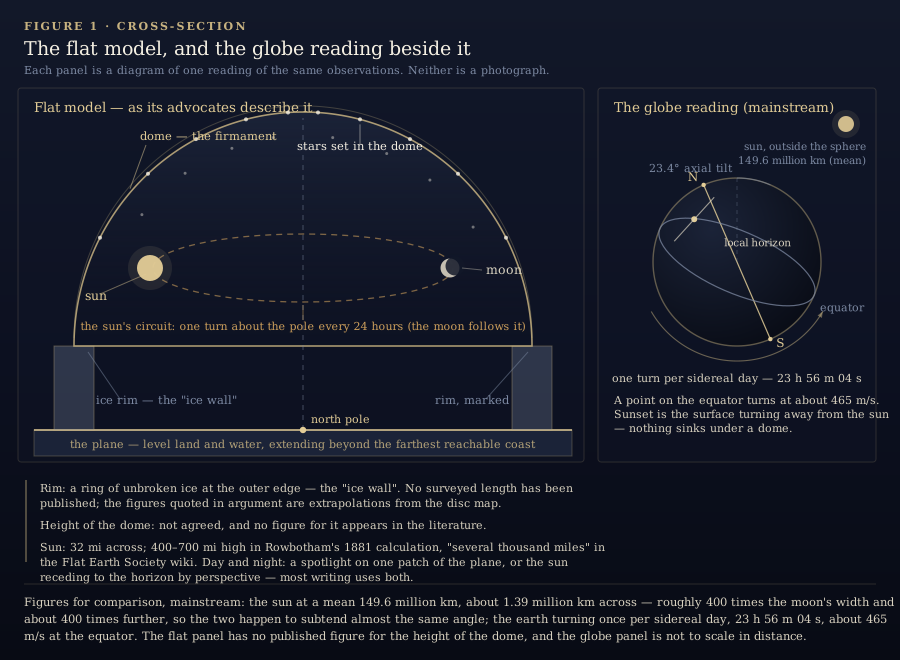
That rim does a lot of work and carries a lot of weight. It is what stands where the globe model puts a continent at the bottom of the world, and — this is the honest part — no flat-earth source has published a surveyed length for it, because nobody claiming the model has circumnavigated it. Lengths asserted for it in argument are extrapolations from the disc map, not measurements.
The sun's circuit, and why night happens
In the model the sun is not a body being orbited. It is a light that circles above the plane, running a full circuit around the pole once every 24 hours, at a constant height. The moon does the same. Day and night then have to be produced without the sun ever passing underneath anything.
Two explanations circulate. The first is the spotlight reading: sunlight falls on one circular patch of the plane at a time, so that a person in the light and a person on the far side are simply in different places relative to the same circuit. The second is the perspective reading, which is Rowbotham's: the sun recedes towards the horizon and is lost to view by distance and the convergence of sightlines, the way a ship's hull is said to be lost, rather than by dipping below a surface. Most flat-earth writing uses both at once, in different paragraphs, and does not always notice.
Seasons without an orbit
The seasons are handled by widening and narrowing the sun's circuit. In June the circle it runs is small and close to the pole, which keeps it over the northern parts for most of the day; by December the circle has grown large and pushed out towards the rim, which does the same for the southern parts. The extremes are set by observation rather than theory: the sun's northern and southern limits are the tropics, about 23.4 degrees either side of the equator, so the model simply draws the largest and smallest circuits to land on those lines. The result reproduces the seasonal swing of daylight and the movement of the overhead sun. What it does not reproduce as neatly is the temperature lag — the fact that the hottest weeks come a month or more after the longest days — which the globe model explains through the heat capacity of land and ocean and the flat model mostly passes over.
The sun's apparent size does not visibly change from rising to noon to setting. On the close-sun reading the distance to the sun changes by a factor of several over the course of a day, which should make it visibly larger at noon and smaller at the horizon, and it does not. Every flat reading has to answer this, and the answers differ. The same observation is the reason the mainstream model places the sun at about 149.6 million km, where a daily distance change of a few thousand km is imperceptible.
The distance question, close sun against far sun
This is the crack running through the model, and it is the most interesting thing on the page. Numbers in play:
- The close sun. Rowbotham, working from his own sightings in the 1881 edition of Zetetic Astronomy, concluded the sun's lower edge lies somewhere under 700 statute miles above the plane, and put its diameter at roughly 32 miles. The Flat Earth Society's own wiki today gives the sun a diameter of 32 miles and a height of “several thousand miles” — a sphere rather than a flat light, but still a small body close to the plane.
- The far sun. Other writers keep the sun at a great distance and a size near the mainstream figure, arguing that the close-sun reading is a mistake that has damaged the case. On this reading the sun is not a lamp circling a few hundred miles up; it is a large body far above the plane.
The disagreement is not decorative — the two readings are hard to hold at the same time, and the community knows it. A sun a few hundred or a few thousand miles up, seen from two places a few hundred miles apart, would appear in very different parts of the sky to each observer, and beams coming down through cloud gaps would visibly diverge. Observed beams are close to parallel, which is the standard argument for a distant sun and the strongest internal pressure on the close-sun numbers. Conversely, a distant sun has to explain how it can be hidden by the horizon of a level plane at all, since a light far above a flat surface should remain visible from everywhere on it.
Astronomy puts the sun at a mean distance of about 149.6 million km, with a diameter near 1.39 million km — which makes it about 400 times wider than the moon and about 400 times further away, so the two happen to subtend almost the same angle in the sky. Sunset is then simply the horizon of a rotating body turning away from the sun, and the small apparent size change over a day is real but far too small to see. Nothing in the mainstream account depends on the sun being small or near.
The dome above
Over the plane sits the firmament: an expanse carrying the stars, with the northern stars wheeling around the pole. The vocabulary for this is on the firmament page, and the flat model borrows it wholesale: the raqia of Genesis 1, the solid heaven of the Greeks, the vault of the 1611 English Bible, all pressed into service for the same structure. How high the dome is, and whether it is solid, transparent or something else, is not agreed, and no figure for its height is given anywhere in the literature.
What the model has not settled
A page that only listed the model's successes would be dishonest, and the community's own forums are full of the rest. Standing unresolved:
- The southern sky. Stars wheel around a southern centre that the model has no obvious place for. This is the point the globe side presses hardest, and we take it up on the stars page.
- The midnight sun, and 24-hour daylight inside the polar circles, which the spotlight reading has to construct rather than derive.
- Eclipse geometry: how a shadow falls on the moon as it does, and how a lunar eclipse can be seen while the sun is still above the horizon — a selenelion, a real observation the mainstream account explains by atmospheric refraction.
- Distances across the southern hemisphere. No flat-earth distance table for southern city pairs has been published that satisfies both the disc and the timetable; the argument is made from the map rather than from a survey.
- One model. The community has not agreed on a single diagram, a single sun height, or a single mechanism for day and night, and any page that presents a tidy one is presenting one faction's version.
The fair summary is that the flat model is a set of fittings around a level surface, some of which fit the observations well, one of which — the sun's distance — is not agreed on even internally, and several of which are known to be unfinished business. Its advocates argue that the alternative requires just as much fitting; that argument is set out at length on Objections, answered, and the observations themselves can be checked on Try it yourself. The projection the model is usually drawn in, and what it does to distances, is on the map page; the vocabulary is in the glossary.
This page presents the flat-earth interpretation as its subject matter. It is a belief-based reading of the observations, not a scientific finding — see About for how we frame claims and for the mainstream sources.