Two skies, one ceiling
Leave a camera open for six hours and the stars draw arcs around a fixed point. Travel south and they draw them the other way round a different point. This file is about what those two skies look like.
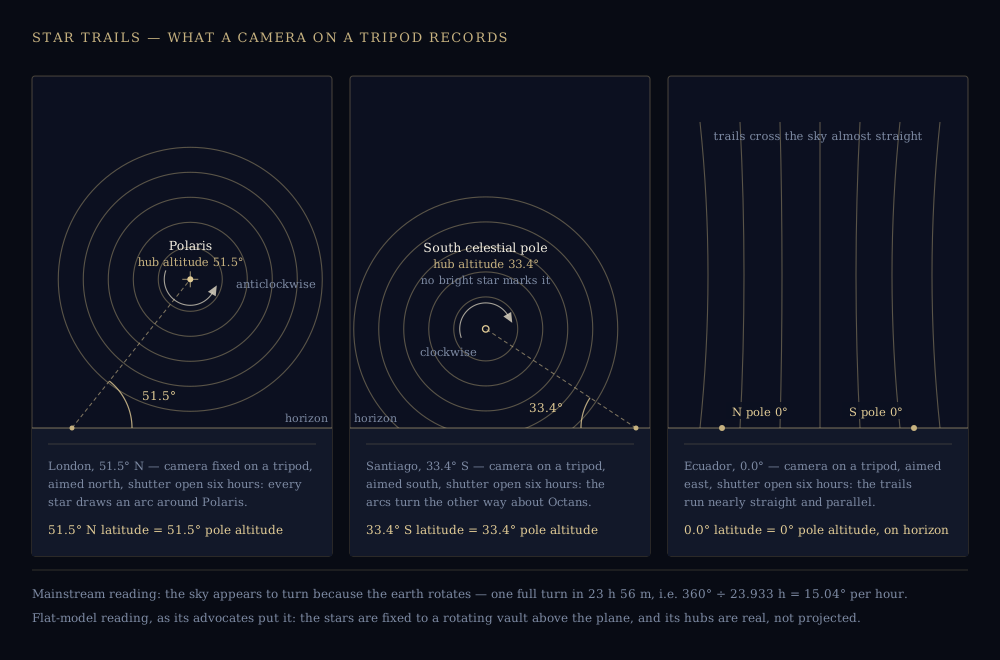
Point a camera at the northern sky, hold the shutter open for several hours and the stars do not sit still. They trace concentric arcs, and every arc is centred on the same small patch of sky. Whatever star you choose, its trail is a ring of the same compass, and the centre of all of them is the star we call Polaris, the North Star.
Now go below the equator and repeat the exercise with the camera pointed south. The same thing happens, but not the same way round. Those stars also circle a fixed point and draw concentric arcs, but the rotation runs the other way — southern trails curve the opposite way — and the centre they circle is not Polaris, which cannot be seen at all from that hemisphere. It sits in a faint, unremarkable constellation with no bright star to mark it. Near the equator, a patient observer looking due south can watch the whole southern sky come up in the east and set in the west without ever rising far above the horizon, while the northern hub is above the horizon on the other side.
Long exposures record the northern stars turning anticlockwise about a point near Polaris and the southern stars turning clockwise about a point in the constellation Octans. The two hubs are separate and the two rotations are opposite, and the southern hub has no bright star at all. No star has ever been seen by the unaided eye to shift against its neighbours because the earth has moved; their patterns are unchanged in the oldest catalogues and the newest photographs alike.
What a fixed sky would mean
The flat-earth reading of the two skies is that the stars are attached to a ceiling above the plane — a firmament or a rotating vault — and that the two centres of rotation are real features of that ceiling rather than projections. The sky north of the equator turns one way about one hub, the sky south of it turns the other way about another, and an observer who moves across the plane sees different sections of the same moving roof. The absence of visible parallax is straightforward on this view: a lamp set into a ceiling does not shift against its neighbours when you walk across the room.
Flat-earth writers press a point about speed here, and it is arithmetic rather than a citation. If the nearest stars are at the distances the mainstream account claims, then a sky completing one turn every twenty-four hours is carrying them around a circle so large that their speed is thousands of times faster than light. On the flat reading this is absurd on its face, and it is one reason the ceiling is preferred to an empty space of near-infinite depth.
The parallax problem
The distinguishing question is parallax. Hold a finger up and look at it with one eye, then the other: it jumps against the background, and the jump is larger the closer the finger is. Apply the same reasoning to the stars and you need a baseline. The earth's orbit provides an enormous one — the earth's position in January and in July differs by about three hundred million kilometres. If the stars were at the distances claimed, each would trace a tiny ellipse against the background as the earth went round, and the size of that ellipse would give its distance.
The flat reading holds that no such shift exists, and that the fact that it took until the nineteenth century to claim even the first detection is a sign that there is nothing to detect. The mainstream reading is that the shift is real, extremely small, and was eventually measured with purpose-built instruments — and that measurements made by different methods, disagreeing at first, have since converged. Both readings are concerned with the same thing: an angle far below what the eye can resolve, and what that silence means.
| Quantity | Figure | Note |
|---|---|---|
| Rotation of the sky | 15.04° / hour | One degree every four minutes |
| Sidereal day | 23 h 56 m 04 s | The interval between two successive transits of the same star |
| Polaris from the north pole of the sky | < 1° | Currently a little more than half a degree, slowly closing |
| Nearest naked-eye star to the south pole of the sky | ~1° | Sigma Octantis, about fifth magnitude and hard to see |
| Parallax of Proxima Centauri | 0.77″ | Below the eye's resolving limit by a factor of about eighty |
| Parallax of 61 Cygni | ~0.31″ | The value Bessel reported in 1838 |
| Resolving limit of the unaided eye | ~60″ | About one minute of arc |
| Aberration constant | 20.49″ | Bradley's figure, published in the 1720s |
| Earth's speed at the equator | ~465 m/s | What the rotation claim requires of a point on the surface |
The mainstream account says the two skies are one sky seen from a rotating earth, and that it never needed to suppose otherwise. A rigid sphere of stars turning about a single polar axis produces exactly the observed picture: a fixed hub in the north, a fixed hub in the south, and opposite apparent rotations in the two hemispheres. That was precisely the pre-Copernican model, and it fits the naked-eye sky perfectly. The difference between a rotating sky and a rotating earth is not what the arcs look like; it is what happens when you measure angles to a precision the eye cannot reach. On this reading the earth turns once every sidereal day, the equator moving at about 465 metres per second, so the sky's rotation is the observer's own motion projected outward.
Stellar parallax was measured successfully. In 1838 Friedrich Bessel used a heliometer to measure the parallax of the star 61 Cygni, reporting a value near 0.31 seconds of arc and a distance of several light years; the modern value for that star is close to his. The nearest star to the sun shows the largest parallax known for a star, about 0.77 seconds of arc, roughly eighty times finer than the eye's resolving limit — which is why no unaided observer has ever seen a star move because of the earth's orbit, and why the claim that stars are fixed is a statement about the eye rather than about the sky. Modern catalogues go far beyond the first detections: the Hipparcos satellite measured parallaxes at milliarcsecond level from 1989, and the Gaia mission reports tens of microarcseconds for bright stars across a catalogue of about 1.8 billion objects.
The measurement that supports the earth's motion most heavily is aberration, discovered by James Bradley in the 1720s, with a constant of about 20.49 seconds of arc — a uniform annual displacement of every star in the same direction, independent of the star's distance, which Bradley interpreted as the earth's motion combined with the finite speed of light. Flat-earth writers commonly reply that aberration depends on the observer's direction and speed but not on any distance, so a moving sky or a moving medium above a stationary earth could in principle produce something similar; mainstream physics notes that no such medium has ever been detected, and that the effect appears in the tracking of artificial satellites as well.
Direct measurement of the earth's rotation is the last item. Léon Foucault's pendulum, hung in the Panthéon in Paris in 1851, kept its plane of swing while the floor turned beneath it, the plane precessing once round the horizon in a period that depends on latitude — about thirty-two hours at Paris, a full sidereal day at the poles, and never at all at the equator. In 1925 Michelson, Gale and Pearson enclosed about a mile of ground with a ring interferometer and registered a shift agreeing with the rotation expected at that latitude. Modern ring laser gyroscopes do the same job continuously.
The band across the sky
One more observation belongs here. The Milky Way is not a patch in one corner of the sky; it is a band that runs all the way around it, and from southern latitudes, where its brightest region is overhead, it can be followed as a complete circle across the entire vault. Under a dark sky a few thousand individual stars are visible to the eye. On the flat reading the band is a ring fixed upon the ceiling; on the mainstream reading it is the disc of our own galaxy seen edge-on from inside it, which is why it wraps around us in every direction we look.
Where this leaves the argument
The flat case in this file is strong on the unaided eye and weak in the instrument. Nothing a person can see with their own eyes distinguishes a rotating ceiling from a rotating earth; the arcs, the fixed hubs and the absent parallax all look the same either way. What distinguishes them is a set of measured angles of a few tenths of a second of arc, which require equipment, calibration and trust in the people doing the measuring — the ground on which this dispute is actually fought.
Read this file with Sun and moon overhead, which covers the same question of measured angles for the nearer lights, and with What the horizon does, which applies the same disagreement to something you can settle with a laser in an afternoon. Objections answered puts the strongest version of the mainstream parallax argument and states how far we think it gets.
This page presents the flat-earth interpretation as its subject matter. It is a belief-based reading of the observations, not a scientific finding — see About for how we frame claims and for the mainstream sources.